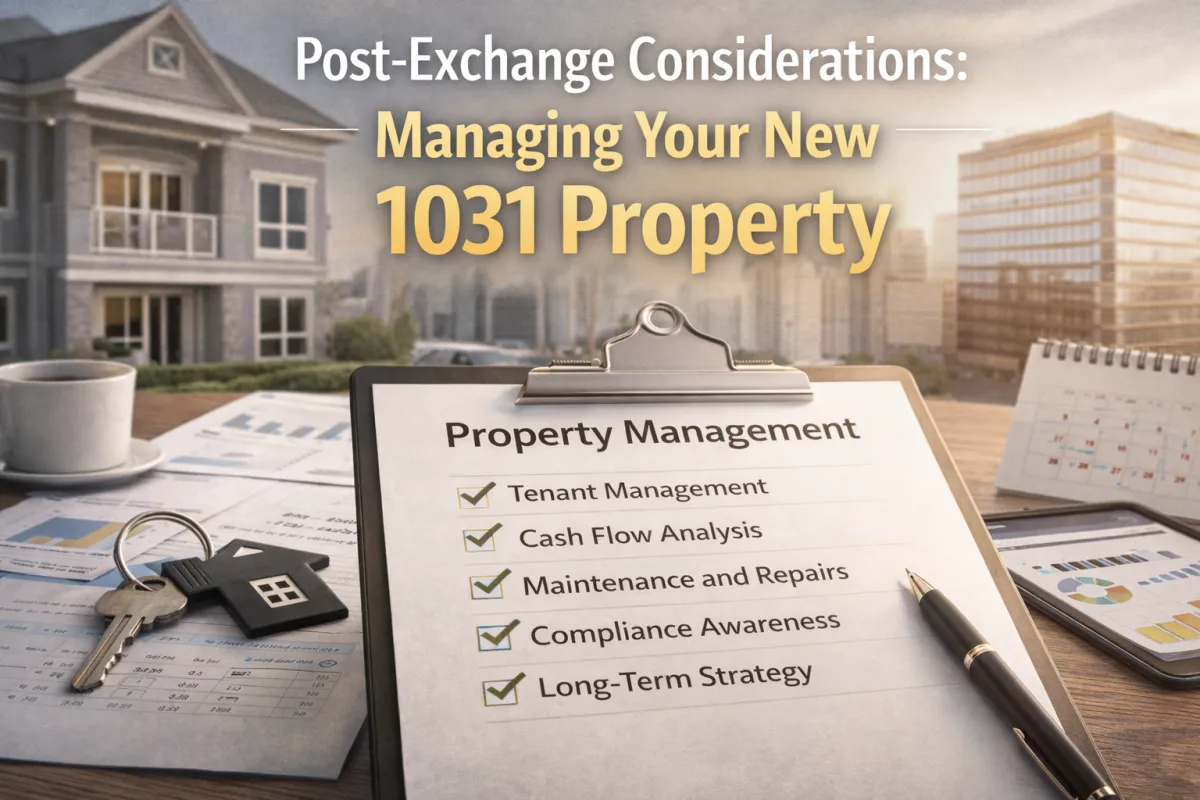
Post-Exchange Considerations: Managing Your New 1031 Property
Post-Exchange Considerations: Managing Your New 1031 Property for Optimal Investment Success

Successfully completing a 1031 exchange is a significant milestone for real estate investors, but the journey doesn't end there. Post-exchange management is crucial for maximizing the potential of your new property and ensuring compliance with IRS regulations. This article will guide you through essential steps and best practices for managing your new 1031 property effectively. You will learn about immediate actions to take after the exchange, how to calculate the tax basis of your replacement property, and strategies for long-term investment planning. Additionally, we will explore the legal considerations and tools that can enhance your property management experience.
Understanding the nuances of post-exchange management can help you avoid costly mistakes and optimize your investment. This guide will cover immediate steps to take, tax implications, property management best practices, and long-term planning strategies. By following these guidelines, you can ensure that your new property serves as a valuable asset in your investment portfolio.
Indeed, beyond immediate tax deferral, 1031 exchanges offer a powerful mechanism for strategic portfolio adjustments and long-term growth.
1031 Exchanges for Portfolio Optimization
Beyond tax deferral, 1031 exchanges serve as a strategic tool for investors looking to optimize and rebalance their portfolios in response to evolving personal goals and market conditions.
The Financial Impact of Real Estate 1031 Exchange: An Equilibrium-Based Analysis, 2025
What Are the Immediate Steps After Completing a 1031 Exchange?
After completing a 1031 exchange, there are several immediate steps you should take to ensure everything is in order. These steps are crucial for confirming the successful completion of the exchange and preparing for any necessary tax reporting.
How to Confirm Exchange Completion and Organize Documentation
To confirm the completion of your 1031 exchange, you should gather and organize the following documentation:
Exchange Agreement: Ensure you have a copy of the exchange agreement that outlines the terms of the transaction.
Closing Statements: Collect the closing statements from both the sale of your relinquished property and the purchase of your replacement property.
IRS Form 8824: This form is essential for reporting the exchange to the IRS and must be completed accurately.
Organizing these documents will not only help you confirm the exchange's completion but also prepare you for any future tax obligations.
What Are the Initial Tax Reporting Requirements Including IRS Form 8824?

After a 1031 exchange, you must report the transaction to the IRS using Form 8824. This form requires detailed information about both the relinquished and replacement properties, including:
Accurate and timely filing of IRS Form 8824 is paramount for documenting the deferred gains and ensuring compliance with tax regulations.
1031 Exchange IRS Form 8824 Filing Requirements
taxpayers must file IRS Form 8824 with their tax return for that tax year.This filing requirement ensures that the IRS is aware of the deferred gains from the exchange. The dollar amount indicates the amount of gains deferred as reported on Form 8824.
Section 1031 Like-Kind Exchange, 2019
Description of Properties: Provide a clear description of both properties involved in the exchange.
Date of Exchange: Indicate the date when the exchange was completed.
Fair Market Value: Report the fair market value of the properties at the time of the exchange.
Understanding these reporting requirements is essential to avoid penalties and ensure compliance with IRS regulations.
How Do You Calculate the Tax Basis of Your Replacement Property?
Calculating the tax basis of your replacement property is a critical step in managing your new investment. The tax basis will affect your future capital gains tax liability when you decide to sell the property.
Understanding how to correctly determine the tax basis of your new property is fundamental, as it directly influences future capital gains calculations.
Calculating 1031 Replacement Property Tax Basis
her tax basis in the replacement property at acquisition is equal to her tax basis in the relinquished property, plus any cash or other unlike-kind property paid to acquire the replacement property.
The benefits and costs of tax deferral: An analysis of section 1031 exchanges, DC Ling, 2020
What Is Adjusted Basis and How Does It Affect Future Capital Gains?
The adjusted basis of your replacement property is determined by the original purchase price, adjusted for any improvements made and depreciation taken. This calculation is vital because it directly impacts your capital gains tax when you sell the property. For example, if you purchased a property for $300,000 and made $50,000 in improvements, your adjusted basis would be $350,000.
How Does 'Boot' Impact Your Taxable Events After Exchange?
In a 1031 exchange, "boot" refers to any cash or non-like-kind property received in the exchange. Receiving boot can trigger taxable events, as it is considered a gain. For instance, if you sell a property for $500,000 and purchase a replacement property for $450,000, the $50,000 difference is considered boot and may be subject to capital gains tax.
What Are Best Practices for Managing Your New 1031 Exchange Property?

Effective property management is essential for maximizing the value of your new 1031 exchange property. Implementing best practices can help you maintain the property, foster positive tenant relations, and ensure financial oversight.
How to Establish Effective Property Management and Tenant Relations
Establishing a solid property management strategy involves:
Clear Communication: Maintain open lines of communication with tenants to address concerns promptly.
Regular Maintenance: Schedule regular maintenance checks to keep the property in good condition.
Tenant Screening: Implement a thorough tenant screening process to ensure reliable occupants.
These practices can enhance tenant satisfaction and reduce turnover, ultimately benefiting your investment.
What Financial Oversight and Accounting Methods Should You Use?
Implementing robust financial oversight is crucial for managing your 1031 exchange property effectively. Consider the following methods:
Budgeting: Create a detailed budget that includes all property-related expenses, such as maintenance, taxes, and insurance.
Accounting Software: Utilize property management software to track income and expenses efficiently.
Regular Financial Reviews: Conduct regular reviews of your financial statements to identify any discrepancies or areas for improvement.
These financial practices will help you maintain a clear understanding of your property's performance and profitability.
How Can You Plan Long-Term Investment and Exit Strategies Post-Exchange?
Long-term planning is essential for maximizing the benefits of your 1031 exchange property. By considering various investment strategies, you can position yourself for future success.
What Are Diversification Options Including DSTs and Different Asset Classes?
Diversification is a key strategy for reducing risk in your investment portfolio. Consider the following options:
Delaware Statutory Trusts (DSTs): These allow you to invest in fractional ownership of larger properties, providing diversification without the need for direct management.
Different Asset Classes: Explore investments in various asset classes, such as commercial real estate, residential properties, or REITs, to spread risk.
Diversifying your investments can enhance your portfolio's resilience and potential for growth.
How Does Estate Planning Benefit from 1031 Exchanges and Step-Up in Basis?
Incorporating 1031 exchanges into your estate planning can provide significant tax advantages. The step-up in basis allows heirs to inherit properties at their current market value, potentially eliminating capital gains tax on appreciation prior to inheritance. This strategy can be particularly beneficial for long-term investors looking to pass on wealth to future generations.
What Legal and Ownership Changes Must Be Addressed After a 1031 Exchange?
After completing a 1031 exchange, it is essential to address any legal and ownership changes to ensure compliance with IRS regulations.
How to Handle Legal Entity and Title Changes to Comply with IRS Rules
If you held the relinquished property in a legal entity, such as an LLC, you must ensure that the replacement property is also held in the same entity or by the same taxpayer. This consistency is crucial for maintaining the tax-deferred status of the exchange. Additionally, any title changes should be documented properly to avoid complications in the future.
Can You Change Ownership or Title Without Affecting Exchange Validity?
Changing ownership or title after a 1031 exchange can jeopardize the validity of the exchange. It is essential to consult with a qualified intermediary or tax advisor before making any changes to ensure compliance with IRS rules and maintain the tax-deferred status of your investment.
Which Tools and Technologies Enhance Property Management for 1031 Investors?
Utilizing the right tools and technologies can significantly enhance your property management experience. Here are some recommended options:
What Property Management Software and Platforms Are Recommended?
Several property management software options can streamline your operations:
Buildium: Offers comprehensive property management features, including tenant screening and maintenance tracking.
AppFolio: Provides user-friendly interfaces and mobile access for managing properties on the go.
TenantCloud: A cost-effective solution for small landlords, offering essential management tools.
These platforms can help you manage your properties more efficiently and effectively.
How to Budget for Maintenance and Capital Improvements Effectively?
Budgeting for maintenance and capital improvements is crucial for preserving the value of your property. Consider the following strategies:
Set Aside Reserves: Allocate a portion of your rental income for unexpected repairs and maintenance.
Plan for Major Improvements: Identify potential capital improvements and budget for them in advance to avoid financial strain.
Regularly Review Expenses: Conduct periodic reviews of your maintenance expenses to identify trends and adjust your budget accordingly.
By implementing these budgeting strategies, you can ensure that your property remains in excellent condition and retains its value over time.
Strategy Description Benefit: Clear Communication, Maintain open lines with tenants, Enhances tenant satisfaction, Regular Maintenance, Schedule checks and repairs, Preserves property value, Tenant Screening, Implement thorough processes, Reduces turnover risk
Tool Feature Application: Build Tenant screening, Streamlines tenant selection, AppFolioMobile access, Manages properties on the go TenantCloud, Cost-effective Ideal for small landlords
By following these guidelines and utilizing the right tools, you can effectively manage your new 1031 property and maximize its potential as a valuable investment.
Frequently Asked Questions
What are the tax implications of selling a 1031 exchange property?
When you sell a property acquired through a 1031 exchange, the tax implications can be significant. If you sell the property without engaging in another 1031 exchange, you may be liable for capital gains taxes on any appreciation since the original purchase. However, if you reinvest the proceeds into another like-kind property through a new 1031 exchange, you can defer these taxes. It's essential to consult a tax professional to understand your specific situation and ensure compliance with IRS regulations.
How can I ensure compliance with IRS regulations after a 1031 exchange?
To ensure compliance with IRS regulations after a 1031 exchange, it is crucial to maintain accurate records of all transactions, including the exchange agreement, closing statements, and IRS Form 8824. Additionally, you should adhere to the timelines set by the IRS for identifying and acquiring replacement properties. Consulting with a qualified intermediary or tax advisor can also help you navigate the complexities of compliance and avoid potential pitfalls that could jeopardize the tax-deferred status of your exchange.
What are the risks associated with 1031 exchanges?
While 1031 exchanges offer significant tax benefits, they also come with risks. One major risk is the potential for failing to meet the strict timelines for identifying and closing on replacement properties, which can result in losing the tax deferral benefit. Additionally, market fluctuations can affect the value of replacement properties, and receiving "boot" can trigger tax liabilities. It's essential to conduct thorough due diligence and have a solid exit strategy to mitigate these risks effectively.
How can I effectively manage tenant relationships in my 1031 exchange property?
Effective tenant management is vital for the success of your 1031 exchange property. Start by establishing clear communication channels to address tenant concerns promptly. Implement a thorough tenant screening process to ensure reliable occupants and reduce turnover. Regular maintenance checks can also enhance tenant satisfaction by ensuring the property remains in good condition. Building positive relationships with tenants can lead to longer leases and a more stable income stream, ultimately benefiting your investment.
What should I consider when planning for capital improvements on my property?
When planning for capital improvements on your 1031 exchange property, consider the potential return on investment (ROI) for each project. Prioritize improvements that enhance property value or attract higher-quality tenants. It's also wise to budget for these improvements in advance, setting aside reserves from rental income to cover unexpected costs. Regularly reviewing your property's condition and market trends can help you identify the most beneficial improvements to undertake, ensuring your investment remains competitive.
How can I leverage technology for better property management?
Leveraging technology can significantly enhance your property management efficiency. Consider using property management software like Buildium or AppFolio, which offer features such as tenant screening, maintenance tracking, and financial reporting. These tools can streamline operations, reduce administrative burdens, and improve communication with tenants. Additionally, utilizing online payment systems can facilitate timely rent collection. By embracing technology, you can manage your 1031 exchange property more effectively and focus on strategic growth.
Conclusion
Effectively managing your new 1031 exchange property is essential for maximizing its investment potential and ensuring compliance with IRS regulations. By implementing best practices in property management, financial oversight, and long-term planning, you can safeguard your asset and enhance its value. Take the next step in your investment journey by exploring our resources and tools designed to support your property management needs. Start optimizing your investment today for a prosperous future.
Visit our Website
Subscribe to our Newsletter
Join our Online Community
Book a Strategy Call with one of our Advisors
